How many breaths have you taken today?
Take a moment and ask yourself a simple question.
How many breaths have you taken today?
The answer is probably:
"I have no idea."
That is exactly how your breathing is supposed to work.
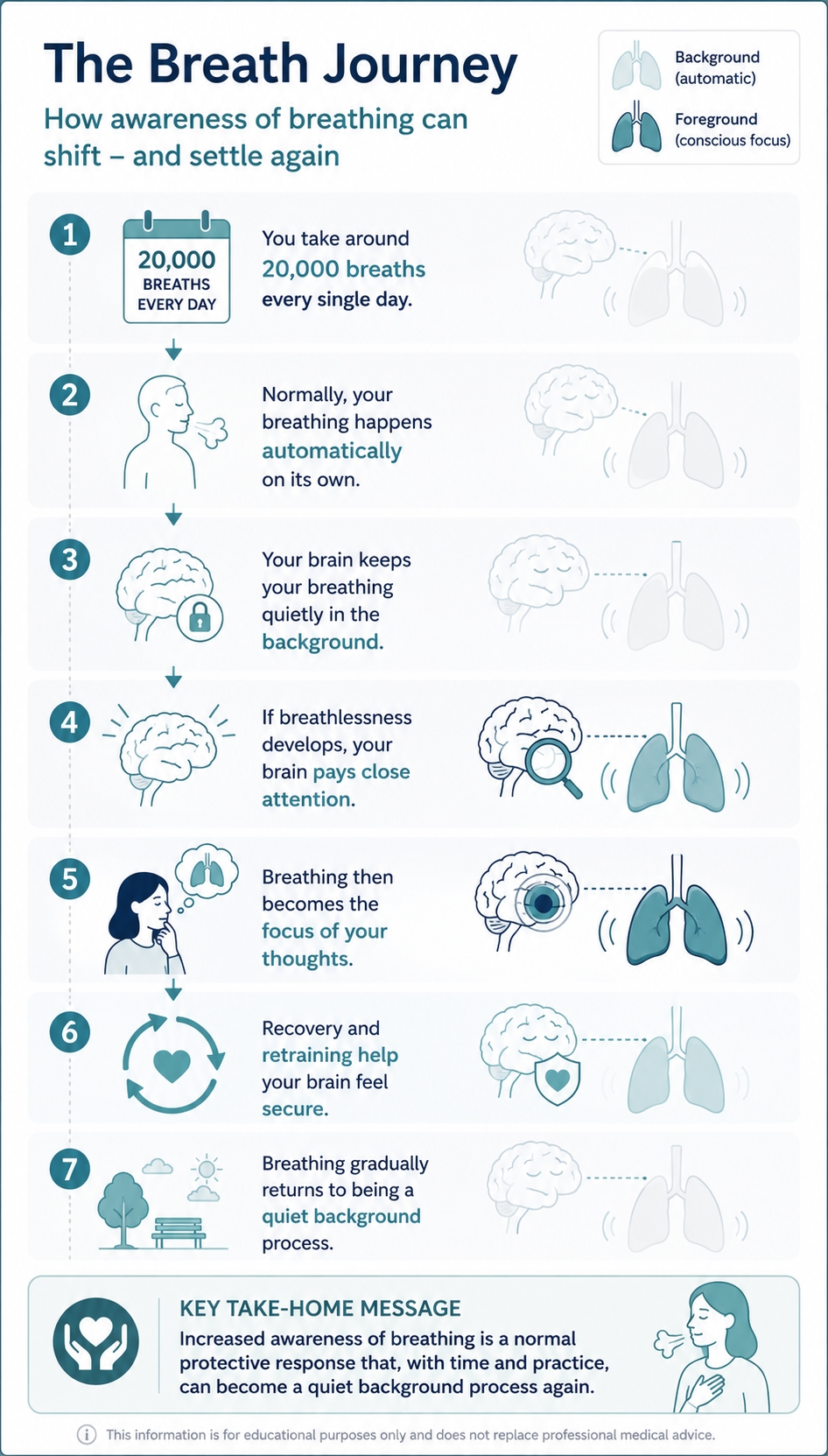
Most adults take around 20,000 breaths every day, yet almost all of them happen without any conscious effort.
Your brain quietly manages breathing in the background while you focus on everything else in your life.
Only when your brain believes breathing has become important does it move into your conscious awareness.
So why does breathing suddenly become impossible to ignore when you develop chronic breathlessness?
The answer lies not only in the lungs, but also in the brain.
Breathing is usually automatic
Breathing is controlled by specialised centres within the brain that constantly adjust your breathing rate and depth.
It is one of the most sophisticated automatic processes in the human body.
These centres respond to changing levels of oxygen, carbon dioxide and physical activity without you having to think about it.
Whether you are sleeping, talking, walking or reading this article, your breathing is being adjusted automatically.
Most of the time, you are completely unaware it is happening.
Your brain decides what deserves attention
Your brain processes an enormous amount of information every second.
It cannot consciously focus on everything.
Instead, it filters information and directs your attention towards what seems most important.
You normally do not notice your heartbeat.
You are not constantly aware of your clothes touching your skin.
You rarely think about your breathing.
These sensations remain in the background because your brain has decided they do not require your attention.
When breathing moves into the foreground
If breathing suddenly becomes more difficult, everything changes.
Perhaps you develop a chest infection.
You climb a steep hill.
Or you experience an episode of chronic breathlessness.
The brain immediately shifts breathing from the background into the foreground of your awareness.
Instead of simply breathing, you begin thinking about breathing.
You notice every breath.
You wonder if you are getting enough air.
Your attention becomes focused on your breathing.
This is a completely normal protective response.
Your brain is trying to keep you safe by paying closer attention to something it believes may be important.
Expectations influence attention
Once breathing has repeatedly become associated with discomfort, the brain begins to expect problems.
You may find yourself checking your breathing more often.
You become aware of small changes that would previously have gone unnoticed.
The more often your brain checks your breathing, the easier it becomes to notice even very small changes.
This increased attention is not a sign that something new is necessarily happening within the lungs.
Instead, it reflects how the brain decides what information is important.
Over time, this heightened awareness can make breathing feel even more intrusive.
Breathing can return to the background
There is good news.
The brain is remarkably adaptable.
Just as it can learn to pay close attention to breathing, it can also learn that breathing is safe again.
Breathing retraining, pulmonary rehabilitation, relaxation techniques and gradual increases in activity all provide opportunities for the brain to develop new experiences.
As confidence grows, breathing often becomes less dominant in everyday life.
Many people describe reaching a point where they stop thinking about every breath.
Most of us never notice the vast majority of the 20,000 breaths we take each day.
One of the aims of modern breathlessness management is not simply to improve breathing itself, but to help breathing gradually become less dominant in your thoughts.
For many people, that represents an important step towards living well again.
Did you know?
An average adult takes around 20,000 breaths every day, yet almost every one of them happens without conscious thought.
One of the goals of breathlessness management is to help breathing gradually return to being an automatic background process rather than the centre of your attention.
Key messages
- Most people take around 20,000 breaths every day without consciously noticing them.
- The brain automatically controls breathing and usually keeps it outside conscious awareness.
- Breathlessness moves breathing from the background into the foreground because the brain believes it requires attention.
- Previous experiences can increase this attention, making breathing feel more intrusive.
- Effective breathlessness management helps the brain become less focused on breathing over time, allowing it to return towards an automatic process.