Why am I still breathless?
Your treatment has worked.
Your breathing tests are stable.
Your doctor says your condition is well managed.
So why are you still breathless?
This is one of the most common and frustrating questions people living with persistent breathlessness ask. Modern research has shown that breathlessness can sometimes continue despite the best available treatment for the underlying disease.
This is known as Chronic Breathlessness Syndrome.
Recognising this syndrome changes the question from “Why am I still breathless?” to “How can I better understand my breathing and regain confidence in everyday life?”
What is Chronic Breathlessness Syndrome?
Chronic Breathlessness Syndrome describes breathlessness that persists despite appropriate investigation and optimal treatment of the underlying disease.
This does not mean that treatment has failed or that your symptoms are imagined. Instead, it recognises that breathlessness is a complex experience influenced by many interacting factors, including the lungs, heart, breathing muscles, brain, emotions and previous experiences.
Like chronic pain, breathlessness can sometimes become a condition in its own right. For many people, the original illness has improved or stabilised, but the sensation of breathlessness remains.
How common is it?
Chronic breathlessness is far more common than many people realise. Research suggests it affects around one in ten adults living in high-income countries. Among adults over the age of 70, this rises to approximately one in four.
That means millions of people worldwide are living with persistent breathlessness. Despite this, the condition often goes unrecognised.
Many people assume becoming breathless is simply part of getting older, gaining weight or becoming less fit. Healthcare professionals may also focus primarily on treating the underlying disease rather than the ongoing symptom itself. As a result, many people continue to struggle without receiving support that could improve their quality of life.
Breathlessness is more than lung function
It is natural to think that more severe lung disease should always produce more severe breathlessness. In reality, the relationship is much weaker than most people expect.
Two people with very similar lung function tests can experience completely different levels of breathlessness. Some people with significant lung disease remain relatively comfortable, while others with only mild abnormalities find everyday activities exhausting.
Research has consistently shown that the severity of breathlessness predicts future health outcomes better than many traditional measurements, including lung function alone. This tells us something important: the sensation of breathlessness is influenced by much more than the condition of the lungs — a point explored further in when tests are normal but breathlessness continues.
Why can breathlessness continue after treatment?
Breathing is controlled by an incredibly sophisticated system. Your lungs exchange oxygen and carbon dioxide. Your heart circulates oxygen around the body. Your breathing muscles perform the physical work of breathing. Meanwhile, your brain continuously receives information from all of these systems and uses it to construct your experience of breathing.
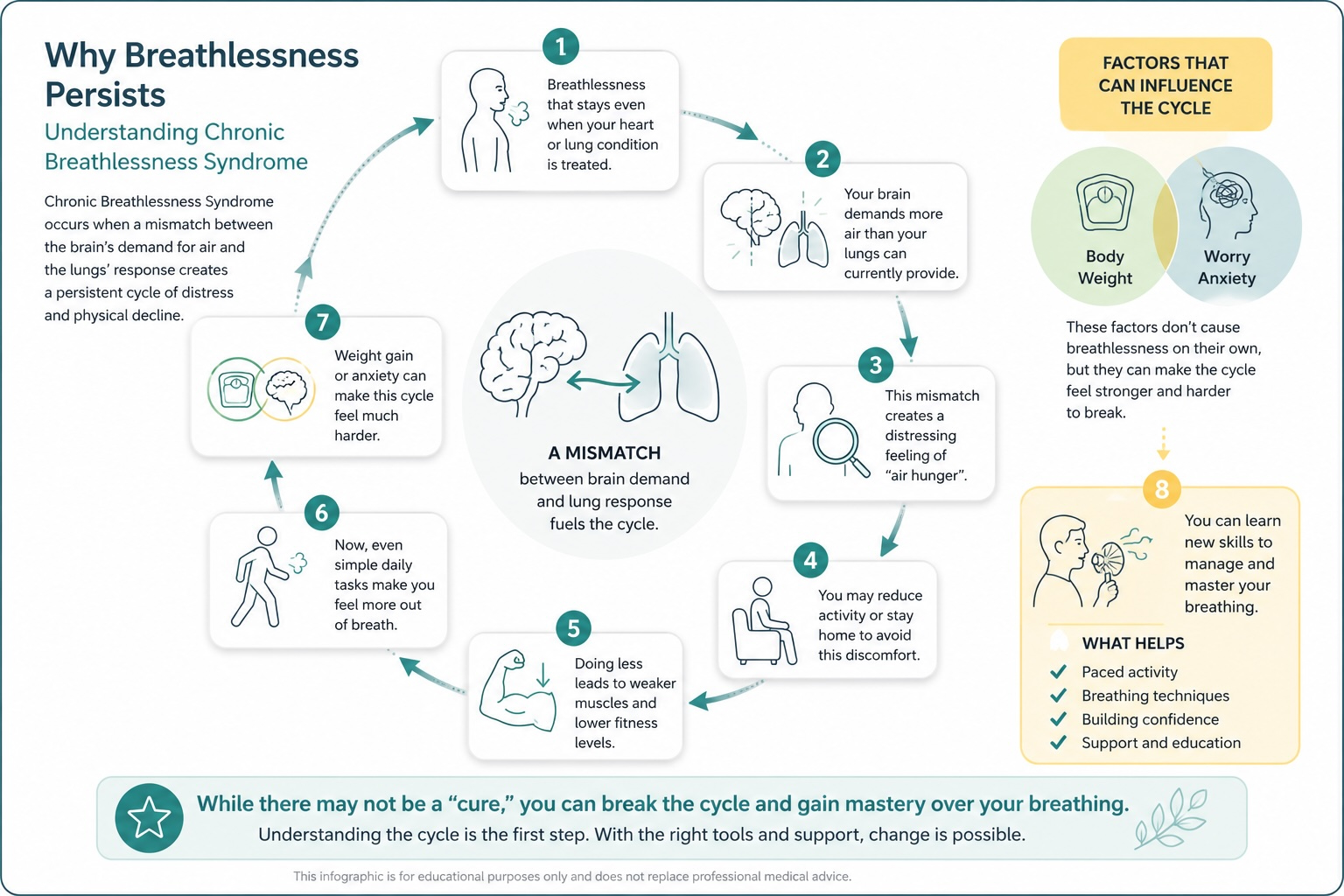
When disease develops, this system responds appropriately by increasing the drive to breathe. Over time, however, the nervous system can become increasingly sensitive. The brain learns to associate certain situations — such as climbing stairs, walking uphill or even thinking about exercise — with breathlessness.
Eventually, breathing may feel more difficult than would be expected from the underlying disease alone. This does not mean the breathlessness is psychological or “all in your head.” It means your brain is doing exactly what it has evolved to do: protect you by responding to what it believes may be a potential threat. Sometimes that protective system becomes over-sensitive — something explored in why breathlessness can feel frightening.
The cycle that keeps breathlessness going
Persistent breathlessness rarely has a single cause. Instead, several factors begin reinforcing one another. Breathlessness makes activity feel more difficult. People naturally reduce activity to avoid unpleasant symptoms. Over time, muscles become less conditioned. Everyday activities require more effort. Breathing feels harder. Confidence falls. Anxiety often increases.
Each part of the cycle strengthens the next, making breathlessness feel progressively more limiting even when the underlying disease has not changed. This is why modern breathlessness services focus not only on identifying disease, but also on helping people interrupt these self-perpetuating cycles — a pattern described in more detail in the breathlessness cycle.
Living well with chronic breathlessness
Although chronic breathlessness cannot always be eliminated, it can often be managed much more effectively. Many people regain confidence, improve their physical activity and reduce the impact breathlessness has on everyday life.
Effective management may include:
- Education about breathlessness
- Breathing retraining
- Pulmonary rehabilitation
- Pacing activities
- Improving physical conditioning
- Relaxation techniques
- Handheld fan therapy
- Digital self-management tools
- Personalised support from healthcare professionals
The aim is not always to make breathlessness disappear completely. Instead, it is to reduce its impact on everyday life and help you regain confidence in your ability to cope. Rebuilding activity and fitness is often a central part of this.
There is reason for hope
Living with persistent breathlessness can be frightening and frustrating, particularly when tests show little change or your condition has already received the best available treatment. Chronic Breathlessness Syndrome helps explain why this happens.
Understanding the syndrome is often the beginning of a different approach — one that focuses not only on treating disease, but also on improving confidence, developing practical skills and rebuilding trust in your body's ability to cope.
Breathlessness may remain part of your life, but with the right knowledge, practical techniques and support, it does not have to define what you are able to do.
Key messages
- Chronic Breathlessness Syndrome describes persistent breathlessness despite optimal treatment of the underlying disease.
- Around one in ten adults experience chronic breathlessness, with prevalence increasing substantially in older age.
- Breathlessness reflects how the brain interprets information from the body, not simply the severity of lung disease.
- Persistent breathlessness often develops through interacting physical, neurological and psychological mechanisms.
- Modern management focuses on improving confidence, function and quality of life alongside treating any underlying medical condition.