Why can I still feel breathless when my tests are normal?
If you've ever been told that your breathing tests are "normal" but you still feel breathless, you may have wondered how that can be possible.
Many people assume breathlessness comes directly from the lungs. It seems logical that damaged lungs should cause severe breathlessness, while healthy lungs should not.
The reality is much more complicated.
Although your lungs, heart and breathing muscles all contribute to breathing, the feeling of breathlessness is created by your brain.
That statement sometimes surprises people. It can even sound as though the symptom is being dismissed.
It is not.
In fact, recognising the brain's role is one of the most important advances in modern breathlessness research.
Every sensation you experience — pain, hunger, thirst, temperature and breathlessness — is ultimately constructed by the brain. Its job is to interpret information from the body and decide what that information means.
Understanding this process helps explain why breathlessness can sometimes feel overwhelming, even when tests show little change.
Breathing happens automatically
Most of us take around 20,000 breaths every day.
Almost all of them happen without conscious effort.
You don't think about each breath while driving, watching television or talking to friends. Your brain controls breathing automatically in the background.
Only when something changes does breathing move into the foreground of your awareness.
This might happen if you sprint for a bus, hold your breath underwater or develop a chest infection. Your brain immediately pays attention because breathing has become important.
Your brain is constantly checking your breathing
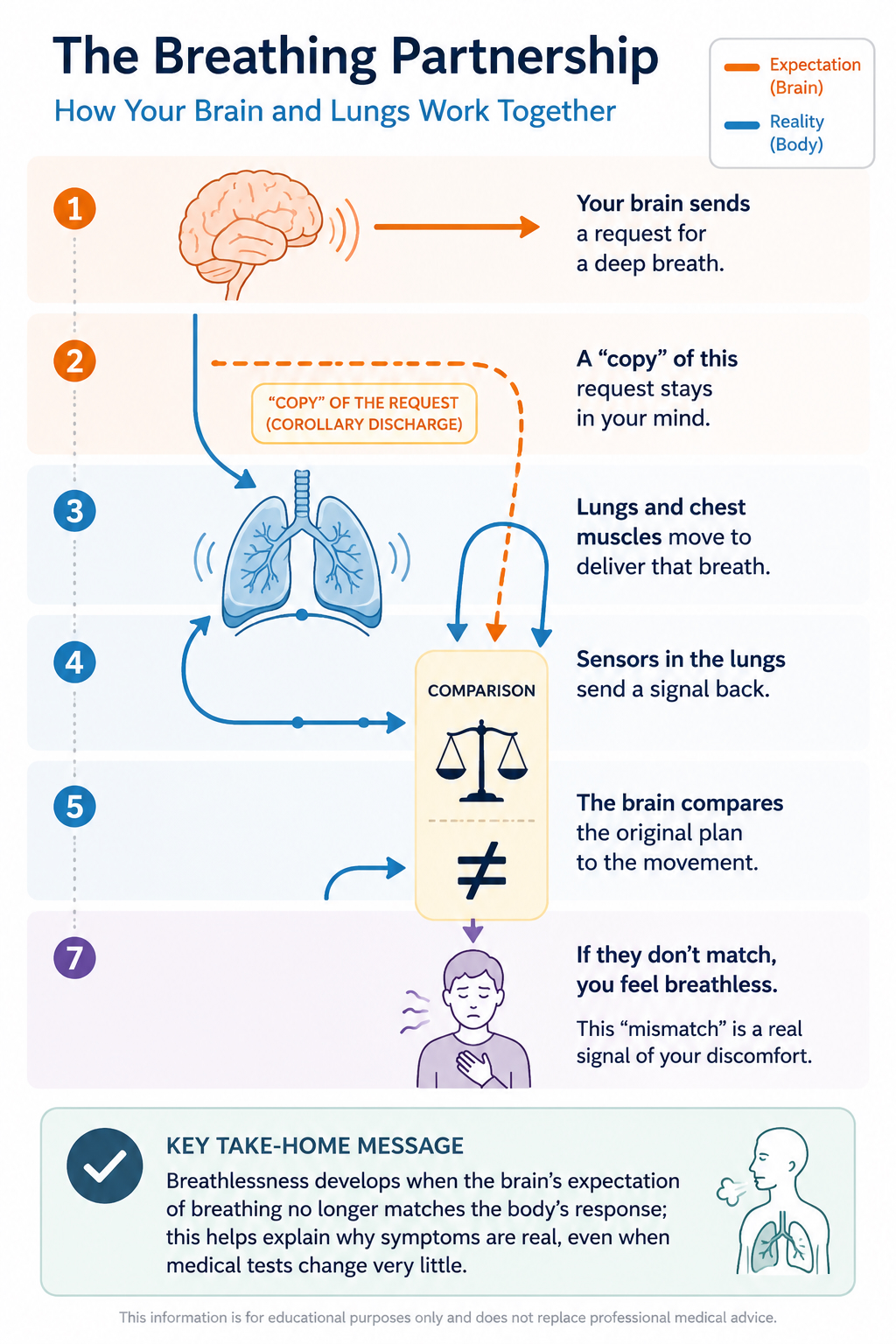
Every breath begins with a signal from the brain.
It tells your breathing muscles how hard to work.
At the same time, the brain receives a continuous stream of information from the lungs, chest wall, diaphragm and blood circulation.
It compares what it expected to happen with what actually happened.
Most of the time, everything matches.
The effort feels appropriate.
Breathing remains comfortable.
The process stays largely outside your awareness.
When expectations and reality no longer match
Sometimes this comparison does not work as expected.
The brain may send a strong command to breathe, yet the lungs or breathing muscles cannot respond as efficiently.
Alternatively, the lungs may be working normally, but the brain still believes breathing should feel difficult.
This difference between what the brain expects and what the body delivers is known as neuromechanical mismatch, sometimes called neuromechanical dissociation.
You can think of it as a conversation that has become out of sync.
The brain says:
"I need more air."
The body replies:
"I'm already doing everything I can."
The brain interprets this mismatch as breathlessness.
The greater the mismatch, the stronger the sensation of breathlessness is likely to become.
Your brain doesn't simply react — it predicts
One of the most exciting developments in breathlessness research is the understanding that the brain is not simply reacting to information from the lungs.
Instead, it is constantly making predictions.
Your brain uses previous experiences to estimate what is about to happen.
This helps you respond quickly and efficiently to the world around you.
Most of the time, these predictions are remarkably accurate.
However, previous experiences can sometimes influence the prediction more strongly than the information arriving from the body.
The phantom phone vibration
Many people have experienced their mobile phone apparently vibrating in their pocket.
You instinctively reach for it.
Then realise…
It never vibrated at all.
Yet for a brief moment, the sensation felt completely real.
Your brain expected a notification and briefly created the sensation.
This is known as the phantom phone vibration phenomenon.
Your brain wasn't malfunctioning.
It simply made its best prediction based on previous experience.
Breathlessness can work in a similar way.
If climbing stairs has repeatedly caused frightening breathlessness in the past, your brain begins to expect that experience.
The next time you approach the stairs, the brain may increase your breathing even before the activity has become physically demanding.
The prediction itself changes how breathing feels.
This does not mean the breathlessness is imaginary. It means previous experiences influence how your brain interprets new information.
Breathlessness is not one feeling
People often describe breathlessness using different words.
That is because it is not a single sensation.
Researchers have identified several distinct experiences.
Air hunger
This is the distressing feeling of not getting enough air.
People often describe it as:
"I can't get a satisfying breath."
It is commonly triggered when the brain senses an increased need to breathe.
Work or effort
Some people do not feel short of air.
Instead, breathing feels physically hard work.
They may say:
"Every breath feels like an effort."
This sensation reflects how hard the brain believes the breathing muscles need to work.
Chest tightness
Others describe a feeling of pressure or tightness across the chest.
This commonly occurs in conditions such as asthma, where receptors in the airways send signals that contribute to this particular sensation.
Although these sensations are different, they are all recognised by the brain as forms of breathlessness.
Why fear makes breathlessness worse
The brain areas involved in breathing are closely linked with those responsible for emotions, attention and recognising potential threats.
If the brain believes breathing is becoming dangerous, it naturally increases your awareness of every breath.
Your breathing becomes the centre of attention.
You begin checking it more frequently.
You may breathe faster.
Your muscles become tense.
The sensation becomes even stronger.
This creates a cycle in which fear increases breathlessness, and breathlessness increases fear.
This is one reason why breathlessness can sometimes feel frighteningeven when oxygen levels remain normal.
Understanding this cycle is important because it shows why reassurance alone is rarely enough.
The nervous system has learned to expect danger.
Breaking that expectation takes time, practice and repeated positive experiences.
Can the brain learn a different response?
There is good news.
The brain remains adaptable throughout life.
Just as it can learn patterns that increase breathlessness, it can also learn patterns that reduce it.
Pulmonary rehabilitation, breathing retraining, pacing, relaxation techniques and digital self-management programmes all work, at least in part, by helping the brain develop more accurate expectations about breathing.
Each successful experience teaches the nervous system that activity can be safe.
Gradually, the mismatch between expectation and reality becomes smaller.
Breathing often feels more manageable.
This process does not happen overnight.
It is built through repeated practice, growing confidence and positive experiences.
Understanding leads to confidence
Understanding how the brain contributes to breathlessness does not make the symptom any less real.
Instead, it helps explain why breathing can sometimes feel overwhelming and, more importantly, why the brain can also learn healthier patterns over time.
Modern breathlessness management is not about convincing yourself that symptoms are unimportant.
It is about helping your brain, body and breathing work together more effectively.
Understanding is often the first step towards regaining confidence.
The following articles explore how breathing patterns, confidence and self-management techniques can help you interrupt the breathlessness cycle and return to the activities that matter most.
Key messages
- Breathlessness is created by the brain after it interprets information from the lungs, breathing muscles and the rest of the body.
- The brain constantly compares what it expects to happen with what actually happens during every breath.
- When those expectations and incoming signals no longer match, a neuromechanical mismatch can develop, making breathing feel uncomfortable.
- Previous experiences influence how the brain predicts future breathing, which can sometimes amplify symptoms even when disease is stable.
- Breathlessness is not a single sensation. Air hunger, breathing effort and chest tightness are different experiences with different underlying mechanisms.
- The brain can learn new patterns. Breathing retraining, rehabilitation and self-management strategies help rebuild confidence and improve the experience of breathing.